


Plan, code, review. Deploy wherever you want.
Upsun Dispatch takes work from plan through code to review, then lands it in your GitHub or GitLab repository. What happens on merge is whatever already happens. Vercel, AWS, your own Kubernetes, or Upsun Cloud.
Without Upsun Dispatch
Every step lives in a different tool
Planning in one place, coding in another, review in your Git provider, deploy in a pipeline. Nothing carries context across the handoffs, so each step starts over.
Adopting one means adopting all
Platforms that cover planning through review usually want the deploy too, so how your team works with agents gets bundled with where the application runs.
Nobody wants to rebuild deploy
Your environments, secrets, rollback path, and months of accumulated fixes live there. A new layer at the front of the chain shouldn't mean rebuilding the end of it.
Built so the fourth step stays yours
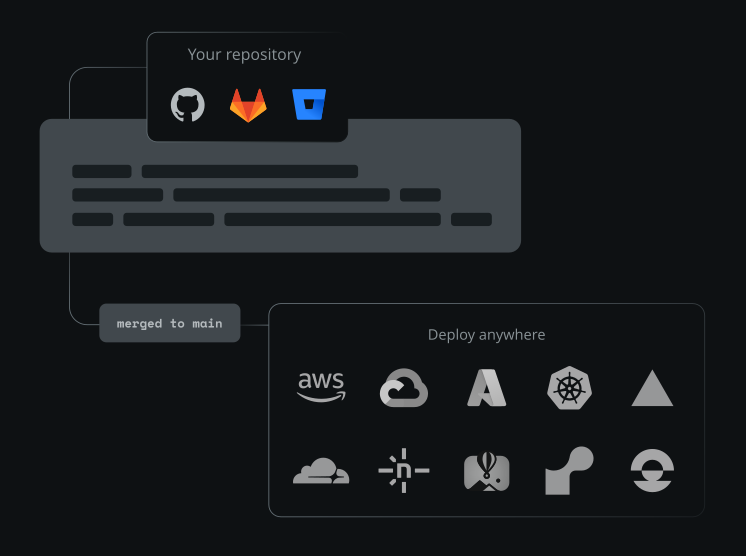
Upsun Dispatch works through your repository. Work enters as an issue or a spec, agents code it in isolated sandboxes, and the change arrives as a pull request for a person to approve.
On merge, your repository does whatever it already did. The deploy path you rely on is untouched, because Upsun Dispatch is not in it.
Plan, code, review. Deploy stays yours.
Upsun Dispatch hands the finished change to your repository as a pull request. What happens after merge is whatever already happened.
- Agent steps run in isolated, disposable sandboxes
- No access to your production environments or deploy credentials
- Changes arrive as a pull request or merge request in GitHub or GitLab
- Your branch rules, required checks, and approvals apply unchanged
- On merge, your existing pipeline runs exactly as before
- Works with GitHub Actions, GitLab CI, Argo CD, or Flux
How it works
Plan
An issue, a ticket, or a rough requirement becomes a plan an agent can act on. Scope, steps, and acceptance criteria written down before anything runs.
Code
Agent steps execute in isolated, disposable sandboxes. Nothing in the workflow has access to your production environment or your deploy credentials.
Review
The change arrives in your repository as a pull request or merge request. Your existing branch rules and required checks apply, and a person approves before it merges.
Deploy
On merge, your pipeline runs. GitHub Actions, GitLab CI, a provider's Git integration, Argo CD, or Flux watching the repository. Upsun Dispatch does not participate in this step.
Works with wherever you deploy today

Teams hosted elsewhere
Your application runs where you chose to run it. How agents contribute to the codebase is a separate question, and answering it does not reopen the first one.

Multi-cloud and hybrid estates
Different services, different targets, sometimes different providers. Upsun Dispatch works the same way across repositories that deploy to entirely different places.

Kubernetes and GitOps
If Argo CD, Flux or other tools already watches your repository, the merge is the deploy. Upsun Dispatch lands the change and your cluster picks it up on its own schedule.

On-premise and private cloud
Your own hardware is a deploy target like any other. If your repository can reach it today, nothing about that changes.

Teams with existing CI/CD investment
Pipelines that took months to get right keep working as they are. Upsun Dispatch adds plan, code and review in front of them, not a replacement for what happens after merge.

Teams evaluating one thing at a time
You can put Upsun Dispatch in front of your agents without touching hosting, and judge it on the first three steps alone. Nothing about the trial commits you to a migration.
Plan, code, review with Upsun Dispatch. Deploy on your terms.
Stay updated
Upsun Cloud: compliant and validated