


Twice the output, reviews in minutes: how Upsun's engineers build with Upsun Dispatch
6-minute read


Challenge
Upsun's engineering team builds and runs the platform behind Upsun Cloud. Review queues, handoff meetings and a long tail of slow merge requests held back how fast the team could turn ideas into shipped code.
Solution
The team adopted Upsun Dispatch in July 2026. Every merge request gets an automatic review within minutes, and tickets assigned in Linear or Jira turn into proposed code changes without anyone opening an editor.
Results
- Output per engineer: merged changes per engineer per week doubled, from 3.3 before AI coding tools to 6.5 today.
- Review speed: the first review lands in a median of 3 minutes, on more than 2,000 merge requests.
- Slowest work: the slowest 10% of merge requests now merge in 99 hours, down from 192.
- Ticket to code: a ticket becomes a proposed change in a median of 13 minutes, with one human approval.
Review was the bottleneck, not the code
Upsun's engineers could write code quickly. Getting it reviewed and merged was the slow part. Before AI coding tools, in 2022 and early 2023, the slowest 10% of merge requests took about 8 days to merge, and the slowest 10% waited 7 days for a first human review.
"When you wake up like this morning and you see Patrick [has been] working all weekend on Dispatch and you see [he] made like 50 different changes and you're like, 'Oh, I need to redo everything. I need to make sure everything works.' That's a mess." —Guillaume Moigneu, Field CTO, Upsun
Review coverage was thin as well. Only 22% of sampled merge requests from that period show any review in GitLab. The rest relied on conversations, pairing or nothing at all.
Work also stalled before it started. A product manager or support lead with a fix in mind had to write a ticket, find an engineer and often book a meeting to explain it. Developers lose about 85 minutes a day to meetings (Microsoft research).
Coding agents added a new load. Fabien Potencier, Upsun's CPO and CTO, felt it first. He has written code for more than 40 years and spent 20 of them reviewing contributions as the creator of Symfony. Running four, five, sometimes ten agents at once, he ended his days more tired than when he wrote the code himself.
“I am the to-do list. I am checking the boxes one after the other.” —Fabien Potencier, CPO and CTO, Upsun
A review on every change, within minutes
The team switched on Upsun Dispatch code review on 22 July 2026. Since then it has reviewed more than 2,000 merge requests across 11 repositories, for 29 people. Most reviews start on their own when a merge request opens or changes. Upsun Dispatch reviews again on every push, a median of 3 times per merge request, so feedback keeps pace with the work.
Upsun Dispatch flags a warning on about half of the changes it reviews, and most get follow-up commits before they merge. Problems get fixed while the author still has the context, before a teammate spends time on them.
Using it first on their own code shaped how it reviews. Early on, every finding landed in one long comment. The team moved findings next to the lines they refer to.
From ticket to code without a meeting
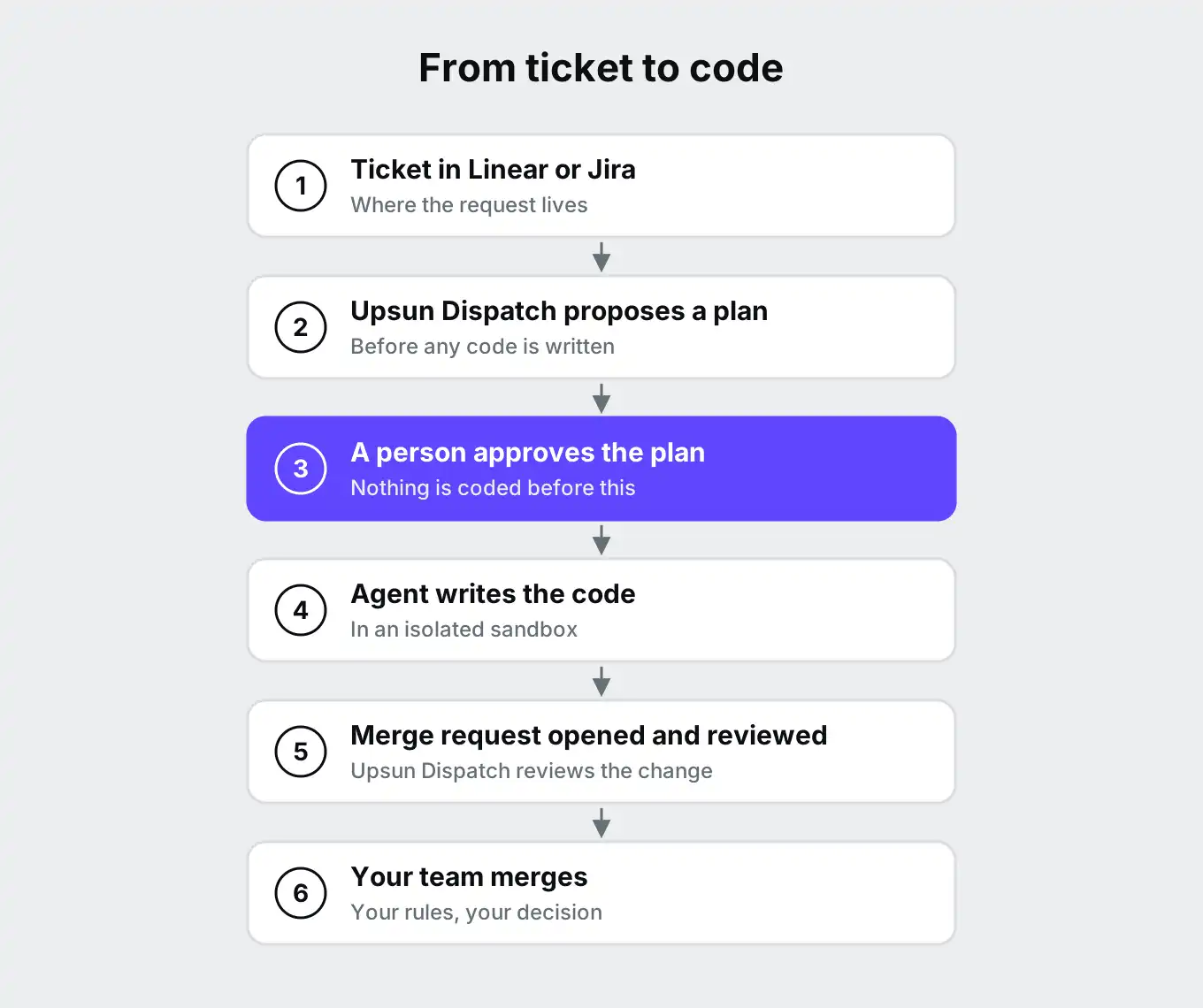
With issue to code, the work starts where the request lives. Assign a ticket in Linear or Jira and Upsun Dispatch plans the change, a person approves the plan, and the agent writes the code and opens a merge request. 97% of Upsun's issue-to-code runs started from Linear or Jira, not from the code host.
“Building software has always been a team sport. It's not just about engineering. It's also about product design, security, ops, stakeholders, clients.” —Fabien Potencier, CPO and CTO, Upsun
The human checkpoint is quick. Across 93 plan decisions, the median approval came 7 minutes after the run started, and 88 plans were approved as written.

Running in the cloud, not on a laptop
Upsun Dispatch runs every job in its own cloud sandbox. Engineers aren't tied to a terminal while an agent works, and many jobs run at once. Developers who prefer their own tools on their own machines keep them. Upsun Dispatch handles review and the queued work around them.
“When you close your laptop, it stops running... I live in London, so in my case, it's getting on the tube. You want to be able to kick off some work from an agent before that and then it not to stop.” —Patrick Dawkins, Principal Software Engineer, Upsun
Twice the output, half the wait
Upsun's engineers now merge twice as many changes per person per week as before AI coding tools, and the slowest work merges in half the time. The figures come from Upsun's own GitLab history and Upsun Dispatch runs, not a survey.
| Measure | Before AI (2022-23) | Now (since July 2026) |
|---|---|---|
| Merged changes per engineer per week | 3.3 | 6.5 |
| Slowest 10% of merge requests, open to merge | 192 hours | 99 hours |
| Slowest 10% of merge requests, Upsun Cloud core team | 464 hours | 190 hours |
| Time to first review | About a day (industry median, Code Climate) | 3 minutes (Upsun Dispatch median) |
| Human comments per reviewed change | 2.8 | 1.6 on the Upsun Dispatch repo |
The gains since July reflect AI across the team, from newer models to coding agents, with Upsun Dispatch at the center of review and queued work. The review figures are Upsun Dispatch's alone.
Less routine review for people
On the repository where Upsun Dispatch reviews every change, human reviewers left 42% fewer comments per reviewed merge request than before AI coding tools. Upsun Dispatch catches the routine issues first, so people spend their review time on design and intent.
Patrick Dawkins, Principal Software Engineer, works on the Upsun Dispatch repository. He started coding with AI in spring 2025 "with a lot of skepticism," approving agents one step at a time. Since Upsun Dispatch review switched on, merged changes there went from 33 a week in the first half of 2026 to 152 a week, while the typical merge time held at around 5 hours.
“For building a software product we're going a lot faster than we ever have before for Dispatch, and I think we're doing that responsibly.” —Patrick Dawkins, Principal Software Engineer, Upsun
Cost per change measured in cents and dollars
A review costs a median of $0.72 per run in model tokens, or $2.13 per merge request across all its reviews. An issue-to-code run costs a median of $1.61. For comparison, Google's engineers spend a median 2.6 hours a week reviewing a median 4 changes (Sadowski et al.). Do the math and that's about 39 minutes per change.
Advice for technical leaders
- Start with review. It needs no change to how anyone writes code, and it pays back on the first merge request.
- Set up routing first. Most of Upsun's early issue-to-code failures were setup problems, such as a ticket that didn't say which repository to change. They ended the run in under a minute, before any code was written.
- Let the requester start the work. Product and support people know what needs fixing. A ticket in Linear or Jira is enough to get a proposed change in front of an engineer.
“Writing code was never the bottleneck really. The code is the easy part really... It's all about the work before writing the code and the work after writing the code. So it's all about the intent.” —Fabien Potencier, CPO and CTO, Upsun
Deploy possibility.
Try Upsun for free.
Stay updated
Upsun Cloud: compliant and validated